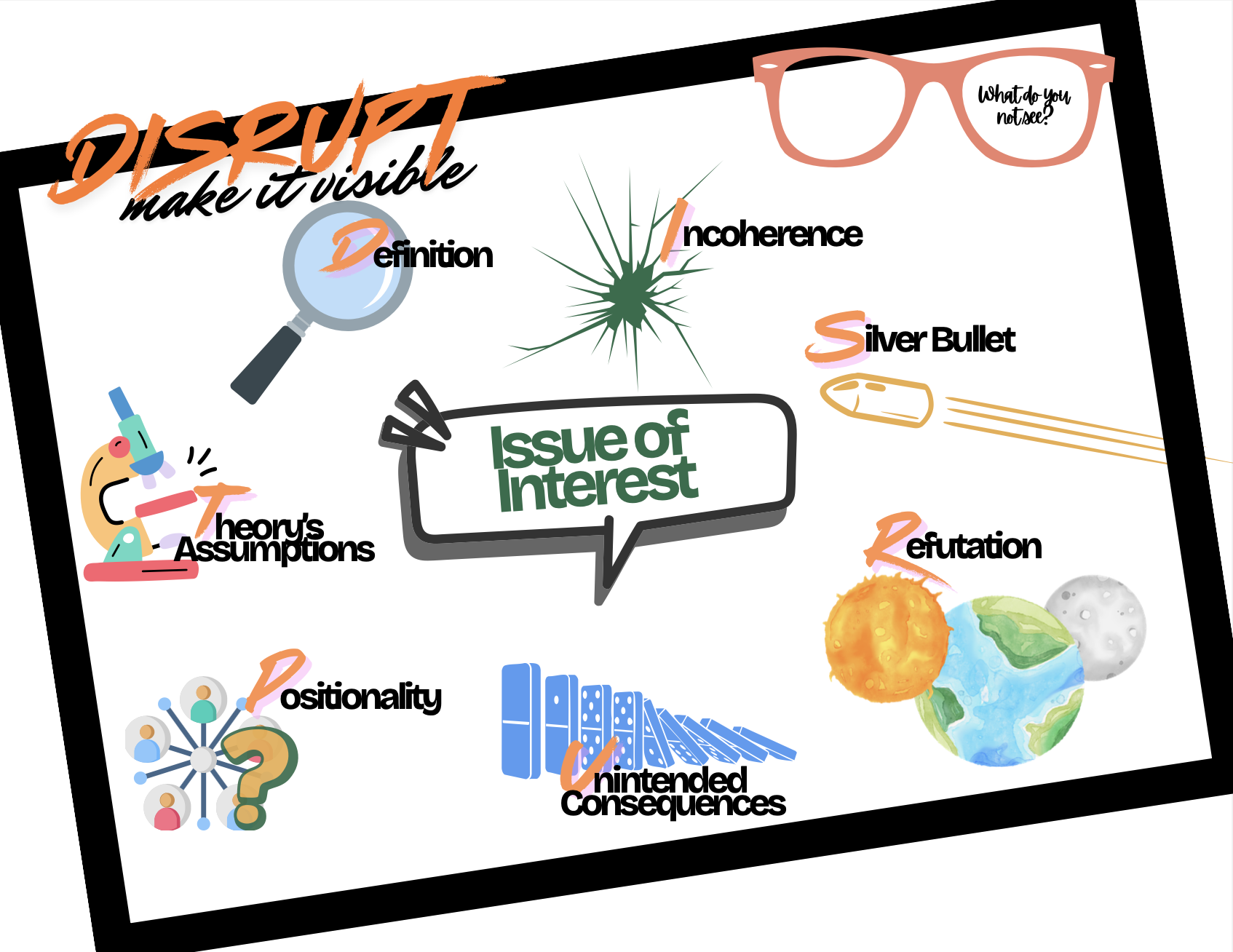
Our DISRUPT journey runs like this -
On Weekly Learning:
By Wednesday: Every week we have a face to face (fsf) session on Wednesday at 8 - 9pm (GMT +8)
Before the f2f session, please do complete the preview materials and bring your questions and ideas - feel free to write comments under the lessons too.
By Friday: After the fsf session, please complete the reflection prompt by Friday evening as a Discussion Post. This will give you and other teachers time to respond to those reflections.
Before the next Wed: Please respond to at least 2 persons' reflections before our next f2f session.
There are extension materials for each module if you'd like to dig deeper into the topics/themes in a more scholarly way. These are not mandatory but can aid your overall understanding of what DISRUPT is about.
On Learning Application:
True learning happens when we transfer and try to apply knowledge to real world contexts.During this course, each person (or form a group) is encouraged to create an evidence of learning. This could be
a. re-designing a unit plan/lesson plans embedding CEL/DISRUPT
b. a short video exploring a topic/issue or news article using CEL/DISRUPT
c. a dramatization of how to hold a robust conversation with someone using CEL?DISRUPT
d. a social media initiative showcasing use of CEL/DISRUPT
e. any other creative application
You will submit your ideas in Week 5 and get feedback. In the last f2f session on Week 8 it's show time!
At any time you encounter glitches or snafus, please be patient and feel free to write for support - support@wonder-educationreimagined.org
Please watch the next video by Prof Ha Joon Chang (previously professor at Cambridge, now at SOAS) on why economics is for everyone. It really is!
Ready? Let's get started!
Many people equate Economics with money. Is that true? Who invented Economics and what problems is it trying to solve? How have we been impacted by the solution of the "price mechanism: that seems to be so natural and inevitable today?
These fundamental questions will be explored this week.
Lesson Objectives -
1. Explain the Economic problem
2. Define key terms: scarcity, resources, allocation of resources, choice, invisible hand, price mechanism
3. Reflect: How have I benefited from the price mechanism at work (Personal Update 1 - 200 words, references needed)
4. Comment on 2 Peers' Reflections (75 words using terms and ideas learned, references not required)

Economics has been around for more than 250 years. During this period, many influential Economists and thinkers with their different theories have come and gone. We must remember that Economics, like any other Social Science, is seeking to describe and explain reality, often with an over-simplification in the use of Economic models and theory. Neoliberalism is one of the more recent economic theory, birthed during the oil crisis of the 70's. However, it has become more than a theory, it has become an ideology. This week we will explore what it is and how insidious and pervasive it is.
Lesson Objectives -
Explain the history and key characteristics of neoliberalism
Identify the neoliberalism at work in our lives
Reflect: Explain what neoliberalism means to you. Describe 1 way you see neoliberalism evidenced in your life or in our world.
Comment on 2 Peers' Reflection (75 words using terms and ideas learned, references not required)

If the invisible hand/ price mechanism works to allocate resources so well, why do we see exorbitant pricing? Wastage? Shortages? Environmental degradation? Depletion of resources?
One way to explain this market failure is to understand that whenever people consume or produce, they could be creating Externalities. So what are Externalities? Where do they lurk? Why do they matter?
Lesson Objectives -
1. Explain what externalities are and how they occur.
2. Define key terms: externality/ external costs/ benefits, indirect tax/ Pigouvian tax
3. Reflect: What are the consequences of not paying the true price on goods and services we consume? (Personal Update 2 - 200 words, use terms and concepts learned)
4. Comment on 2 Peers' Reflections (75 words using terms and ideas learned)

One of the most important market is the Labour Market – how does pricing work and how are wages and unemployment levels determined? Economists have tended not to favor raising minimum wage because they seem to cause the price mechanism to fail and can lead to greater unemployment. At the same time, globalizing forces have impacted the labour market in profound ways. This week we will explore the traditional view about the labour market, David Card's empirical study and why the pricing of labor continues to be a very urgent and contentious issue in our world.
Lesson Objectives -
1. Explain how pricing of labor is determined
2. Define labor, minimum wage and living wage
3. Reflect: What are the economic assumptions about labour and how do these advantage some while they disadvantage others?
4. Comment on 2 peers' reflections
GDP - The most powerful and common economic indicator created? (MM Desk, 2021)
The GDP is one of the most ubiquitous Economic indicator used in our world, yet, how is the Gross Domestic Product actually derived? What is the history to the invention of this statistic and why does the GDP have such power in our social reality? How is this phenomenon linked to the concept of Banking Education that was developed by Freire?
Lesson Objectives:
1. Explain how the GDP is derived
2. Define GDP, economic growth, banking education
3. Reflect: What are the ways I have been “banked” in my education that creates a sense of unbridled faith in the GDP?(Personal Update 4 - 200 words)
4. Comment on 2 Peers' Reflections
Is it possible that Economists got their stories wrong? How did we start with the Economic problem of scarcity but ended up with the drive for endless economic growth? Are there stronger models that reflect better the reality of the world we live in? Are there things we should learn from nature in the movement called biomimicry?
Lesson Objective -
1. Explain the incoherence in the economic stories Economists have made regarding how our economies work
2. Define key terms: linear, circular economy, sustainability, bio-mimicry, Doughnut Economics
3. Reflect: Pick a good/ service that you enjoy, what are the solutions it brings, what are the problems it creates? And what are the implications locally, nationally and globally? (Personal Update 5 - 200 words)
4. Comment on 2 Peers' Reflections

How is neoliberalism like a Velvet Cage? How is Critical Thinking (CT) and Critical Pedagogy (CP) not able to stem the tide of neoliberalism these past 40 years? How is CEL an alternate criticality? We will explore these important questions this week and see how CEL may help free us from this Velvet Cage.
Lesson Objective -
1. Explain neoliberalism as a Velvet Cage
2. Define key terms: CT, CP, CEL
3. Reflect: What is the role of education and educators in promoting Critical GCE and dismantling the Velvet Cage of neoliberalism?
4. Comment on 2 Peers' Reflections
Teachers use this session to present their application of CEL into their professional fields.
There are uploaded samples of teacher's proposals of ways to apply CEL to their grades/subjects.
Hope it inspires you!
CEL can be defined as "the ability to identify, analyze and reflexively question economic models, theories, stories and systems in order to address the power imbalances in our neoliberalized world for greater equity and well-being for people and planet" (Ho, Anderson, Cheng, Ford-Coron, Pilgueva & Wakefield, 2025).
What does CEL mean to you now?
Yay! You made it! Your opinions count towards making this CEL course more meaningful, applicable and accessible for all teachers. Please take a few minutes to complete this survey and set up a 20 minute interview with Cat. Thank you so much!